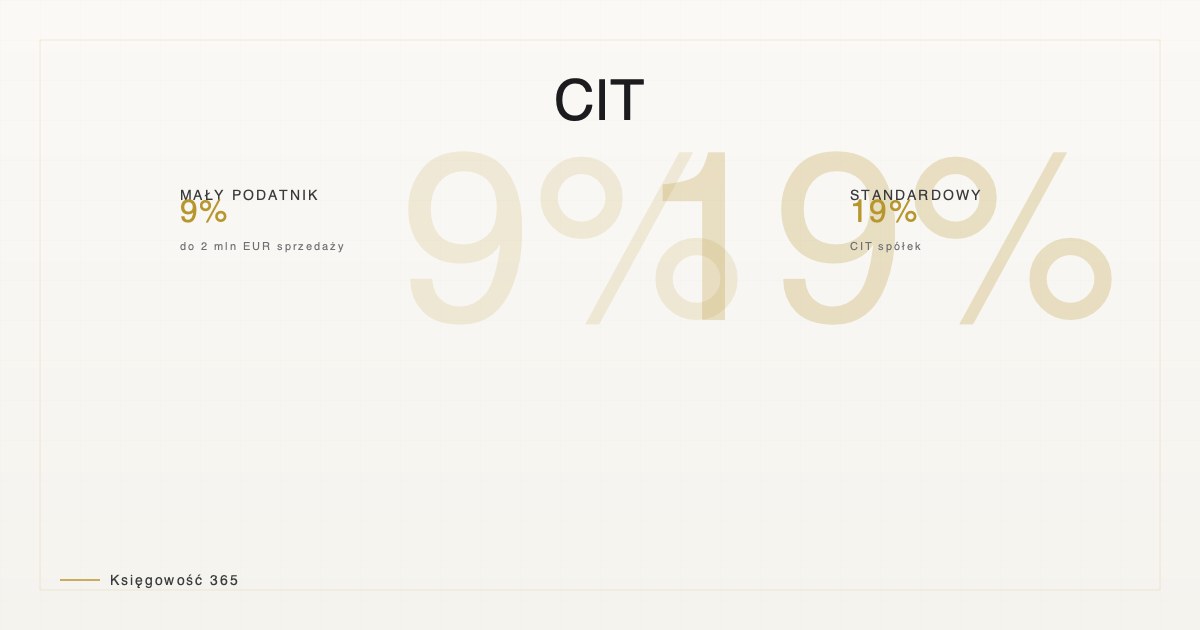
CIT 9% for Small Taxpayer
Limited liability company can pay CIT 9% instead of standard 19%, but only if meeting strict revenue limit criteria. Learn exact 2026 limits (8.431 million PLN net, 8.517 million PLN gross), conditions and economic comparison.
Introduction: What Is CIT 9% for Small Taxpayer?
Poland offers preferential CIT 9% rate for small enterprises. This is not a tax relief you can choose — it is automatically granted status for limited liability companies meeting concrete financial criteria.
In 2026, the system changes revenue limits. Companies must be careful not to exceed threshold and lose preferential rate. Mistake can cost thousands in additional tax.
2026 CIT 9% Limits: Two Criteria You Must Know
CIT 9% in 2026 is not granted based on single limit. Instead, two independent revenue limits must be met simultaneously.
Criterion 1: "Small Taxpayer" Limit (Based on Prior Year)
To be classified as small taxpayer in 2026, company must not exceed 2025 revenue:
8,517,000 PLN gross (with VAT)
Includes sales revenue and all other income from 2025.
Criterion 2: Current Year Limit (During 2026)
Additionally, company revenue in 2026 itself (counted net, without VAT) cannot exceed:
This limit applies to revenue during current tax year (2026).
Key Difference: Gross vs. Net
Many companies confuse these limits. Here is precise explanation:
| Limit | Amount | Includes | For Which Year |
|---|---|---|---|
| "Small Taxpayer" | 8,517,000 PLN | Gross (with VAT) | Prior Year (2025) |
| Current Limit | 8,431,000 PLN | Net (without VAT) | Current Year (2026) |
Example: Company had 2025 revenue 8,400,000 PLN gross (meets 8,517,000 PLN limit). However, 2026 revenue net reached 8,500,000 PLN — exceeds second limit. Must switch to CIT 19% from 2027.
What Happens When You Exceed Limit?
Exceeding either limit has serious tax consequences.
Scenario 1: Exceed Limit During 2026
If 2026 net revenue exceeds 8,431,000 PLN:
- In 2026 you still pay CIT 9% on all revenue
- From 2027 automatically switch to CIT 19%
- No way to return to CIT 9% without reducing revenue
Scenario 2: Planned Growth Beyond Limit
If you know revenue will exceed limit:
- Consider splitting business into two companies (advanced strategy)
- Or plan transition to CIT 19% as less painful option
- Compare CIT 9% savings with administrative costs of two companies
Practical Calculation: CIT 9% vs CIT 19%
Is CIT 9% limit really worth maintaining? Here is concrete comparison.
Example 1: Company with 5 Million PLN Revenue
AT CIT 9%: Tax 90,000 PLN | Net profit: 910,000 PLN
AT CIT 19%: Tax 190,000 PLN | Net profit: 810,000 PLN
SAVINGS with CIT 9%: 100,000 PLN annually
Example 2: Company Near Limit — 8 Million PLN Revenue
AT CIT 9%: Tax 108,000 PLN | Net profit: 1,092,000 PLN
AT CIT 19%: Tax 228,000 PLN | Net profit: 972,000 PLN
SAVINGS with CIT 9%: 120,000 PLN annually
Worth maintaining CIT 9%!
Are There Exceptions to Limits?
Polish tax law allows special cases where you can access CIT 9% despite exceeding limits.
Exception 1: Cooperatives and NGOs
Some cooperatives and non-profit organizations may access preferential rates regardless of limits. Requires special status.
Exception 2: New Company (First 12 Months)
Newly established companies can use CIT 9% in first year even if limits not met. From second year full criteria apply.
Exception 3: Revenue Reclassification
Some revenues (grants, subsidies) may not count toward limit. Requires detailed justification and tax authority approval.
How to Monitor You Are Not Exceeding Limit?
Exceeding limit is usually discovered too late. Here is how to control:
Step 1: Set Alert in Accounting System
Configure notification when revenue approaches 7,500,000 PLN net (still has safety margin).
Step 2: Monitor Revenue Monthly
Each month compare:
- Year-to-date net revenue
- Projection to year-end
- Distance from limit (8,431,000 PLN)
Step 3: Consult Accountant in Q3
In third quarter (July-August) precisely calculate revenue projection for year-end. If exceeding limit, plan remedial actions.
History and Future of CIT 9% Limits
CIT 9% limits change annually. Here is overview of recent and projected changes:
| Year | Gross Limit (2M EUR) | Exchange Rate |
|---|---|---|
| 2024 | 8,720,000 PLN | 4.36 PLN/EUR |
| 2025 | 8,600,000 PLN | 4.30 PLN/EUR |
| 2026 | 8,517,000 PLN | 4.2586 PLN/EUR |
| 2027 (projection) | ~8,400–8,500 PLN | Depends on NBP rate |
Conclusion: Limits decline yearly (due to weakening Polish zloty vs euro). Company with growing revenue always risks exceeding limit within few years.
FAQ: Common Questions
Does CIT 9% apply to self-employment or freelancing?
No. CIT 9% applies only to limited liability companies and partnerships. Self-employed are taxed under personal income tax (PIT), not CIT.
What if I exceed limit by 10,000 PLN?
Exceeding limit by any amount (even 1 PLN) triggers switch to CIT 19% next year. No tolerance or rounding.
Can I actively plan to avoid exceeding limit?
Yes. Many companies deliberately spread revenue across two tax periods or delay invoices to avoid exceeding limit. This is legal but requires careful planning and documentation.
Does limit include gross or net revenue?
Depends on limit: "small taxpayer" (2025) = gross, current limit (2026) = net. Common source of mistakes!
Can I voluntarily switch to CIT 19% before year-end?
Theoretically yes, but requires tax authority notification and creates paperwork. Practically, wait until year-end and switch from next tax year.
Does CIT 9% require full accounting?
Yes. Limited liability company (regardless of CIT rate) must maintain full accounting and file financial statement. Simplified KPiR not allowed for LLC.
Tomasz Dąbrowski
Age: 52 years
Certification: CPA, Master's (Warsaw School of Economics)
Experience: 22 years as auditor and tax advisor, author of articles on CIT and taxation for limited liability companies
Tomasz specializes in income tax optimization for limited liability companies. Has worked with 500+ companies across manufacturing, trade and services. Expert in CIT limits and strategies for maintaining preferential 9% rate.