Do you pay ZUS on B2B?
B2B entrepreneurs must register with ZUS and pay contributions. Learn who must pay, 2026 contribution amounts, relief options (Start relief, Small ZUS Plus), and how to register.
Do you pay ZUS on B2B? Direct answer
Yes, you must pay ZUS contributions on B2B. This is mandatory for anyone running sole proprietorship (JDG) or another business form.
B2B stands for business-to-business collaboration. If you work as sole proprietor or run own business, you are responsible for your own ZUS contributions. This is different from salaried employment where employer pays part of ZUS.
Who must pay ZUS on B2B?
ZUS insurance obligation applies to:
- People running sole proprietorship (JDG)
- Partners of civil law partnerships
- Members of cooperative societies
- People working for own account not registered as employees
Consequences of not paying ZUS
Not paying ZUS contributions has serious consequences:
- Interest and penalties imposed by ZUS on arrears
- Bailiff enforcement of personal property
- Loss of benefits rights (allowances, disability, pension)
- Difficulty obtaining credit—no insurance is negative signal for banks
- Professional registration problems and business opportunities
ZUS contribution amounts for B2B in 2026
In 2026, ZUS contributions for entrepreneur are:
Full contributions (with sickness insurance)
Contributions without sickness insurance
Health insurance separately
Additionally, entrepreneur pays health insurance:
- Minimum PLN 432.54 monthly (from minimum wage)
- Actual amount depends on tax form and income
Example: Total ZUS cost for B2B entrepreneur in 2026
Social contributions (pension, disability, accident): PLN 1,926.76
Health insurance: ~PLN 432.54 (minimum)
Total monthly: ~PLN 2,359.30
Annually: ~PLN 28,311.60
Reliefs and preferential ZUS forms for B2B
Fortunately, law provides several reliefs that can significantly reduce ZUS costs for new or lower-earning entrepreneurs.
Start relief—6 months without ZUS
If starting new business, can use Start relief allowing ZUS exemption for 6 months.
Start relief conditions:
- New business registration (didn't exist before)
- Apply to ZUS within 30 days of CEIDG registration
- Person wasn't entrepreneur for last 5 years (with exceptions)
Start relief savings:
Over 6 months you save approximately PLN 14,000–14,400 on ZUS contributions. Significant cost reduction at business launch.
Small ZUS Plus—contributions based on income
If earning below specified threshold (120% of minimum wage), can choose Small ZUS Plus. Contributions then calculated from individually set base, depending on previous year income.
How it works:
Instead of paying full ~PLN 1,900 contributions, can pay PLN 300–400 monthly if income is low. In 2026, Small ZUS Plus threshold is approximately PLN 5,760 monthly (120% of minimum wage).
When Small ZUS Plus pays off:
- When net revenue below PLN 5,760/month
- When starting or seasonal business
- When combining B2B with salary work (total below threshold)
Preferential ZUS—for newly registered
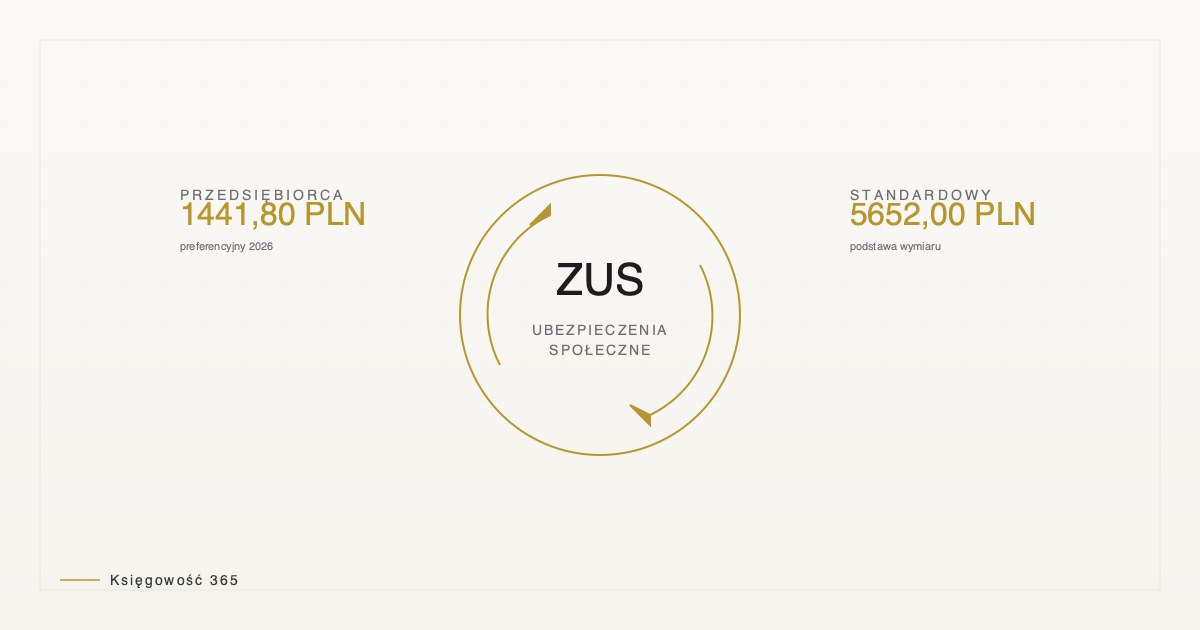
Entrepreneurs registering by year-end can use preferential ZUS with base of 30% minimum wage (in 2026: ~PLN 1,442).
Enables paying much lower contributions in initial business years.
Practical step-by-step for B2B entrepreneur
Step 1: Register business in CEIDG
To start B2B work, register in Central Business Activity Register. Can do online at:
- CEIDG.gov.pl (free)
- County office
- Business information point
Step 2: Register with ZUS within 7 days
After CEIDG registration, register with ZUS within 7 business days via:
- ZUS office visit
- ZUS.pl portal with e-signature
- mZUS mobile app
Step 3: Check relief eligibility
When registering with ZUS, request reliefs:
- Start relief—if new business (apply within 30 days)
- Small ZUS Plus—if earning below threshold
- Sickness insurance—optional, can decline
Step 4: Set up regular contribution payments
After 6-month relief (if received) or immediately, must pay ZUS by 10th of next month. Set up automatic transfers:
- To ZUS account provided in welcome letter
- Via mZUS app
- Through bank online
Step 5: Maintain income records
To qualify for Small ZUS Plus in future years, document income from previous year:
- Invoices issued to clients
- Income register (KPiR or accounting statements)
- Service/contract documentation with dates and amounts
Comparison: B2B with reliefs vs. full ZUS
Scenario 1: B2B with Start relief (6 months)
First 6 months: ZUS PLN 0
Income tax: paid normally
Savings: ~PLN 14,400
Scenario 2: B2B with Small ZUS Plus (PLN 3,500/month income)
ZUS (from ~PLN 1,500 base): ~PLN 350/month
Annually: ~PLN 4,200
Savings vs. full: ~PLN 20,000 yearly
Scenario 3: B2B full contributions (PLN 50k+/month income)
Full ZUS: PLN 1,926.76
Health insurance: ~PLN 4,500
Income tax: ~PLN 9,500 (on PLN 50k)
Total monthly: ~PLN 15,900
No relief access
FAQ: Common questions
Is B2B same as sole proprietorship?
Not exactly. B2B is collaboration form (business-to-business), JDG is legal form. Person working B2B usually runs JDG, but can own company (Sp. z o.o., partnership).
Must I issue invoices on B2B?
Yes, if VAT taxpayer. If VAT exempt (below PLN 240k revenue), can issue invoices without VAT, but must note "VAT exempt".
What if I don't pay ZUS?
ZUS will enforce arrears, charge interest and penalties. Risk loss of benefits, credit denial, and professional registration problems.
Can I do B2B and salary work?
Yes, but you'll pay two contribution groups: as employee (from salary) and entrepreneur (from B2B). Total tax burden can be high.
Are ZUS contributions deductible from income tax?
Partially yes. Sickness and accident insurance contributions may be deductible. Full deduction depends on chosen tax form (KPiR, flat-rate, linear).
Can family members be on B2B?
Theoretically yes, but only if actually working and earning. ZUS can verify whether contracts are real. Fake contracts may result in penalties.
Katarzyna Zielińska
Age: 34 years
Education: Master's in Law (Jagiellonian University Krakow), specialization in HR and labor law
Experience: 10 years in HR consulting and labor law. Helps entrepreneurs with business registration, tax optimization, and social insurance issues.