Estonian CIT
in 2026 — conditions, benefits and pitfalls
Estonian CIT seems like an attractive tax solution for growing companies — but it's not a magic bullet. As a chartered auditor, I've seen companies benefit from it and others run into serious troubles. In this article, I break down how it works, who can use it, the 2026 rules, and the real pitfalls nobody talks about.
What is Estonian CIT and how does it differ from standard CIT?
Estonian CIT is an alternative tax system for commercial companies, originally developed in Estonia and available in Poland since 2020. Its main feature is taxation on a cash basis, meaning tax is calculated on actually distributed dividends and profits, not on net income shown in the financial statement.
Comparison with standard CIT:
| Criterion | Standard CIT | Estonian CIT |
|---|---|---|
| Tax Base | Net profit at year-end | Actually distributed dividends and profits |
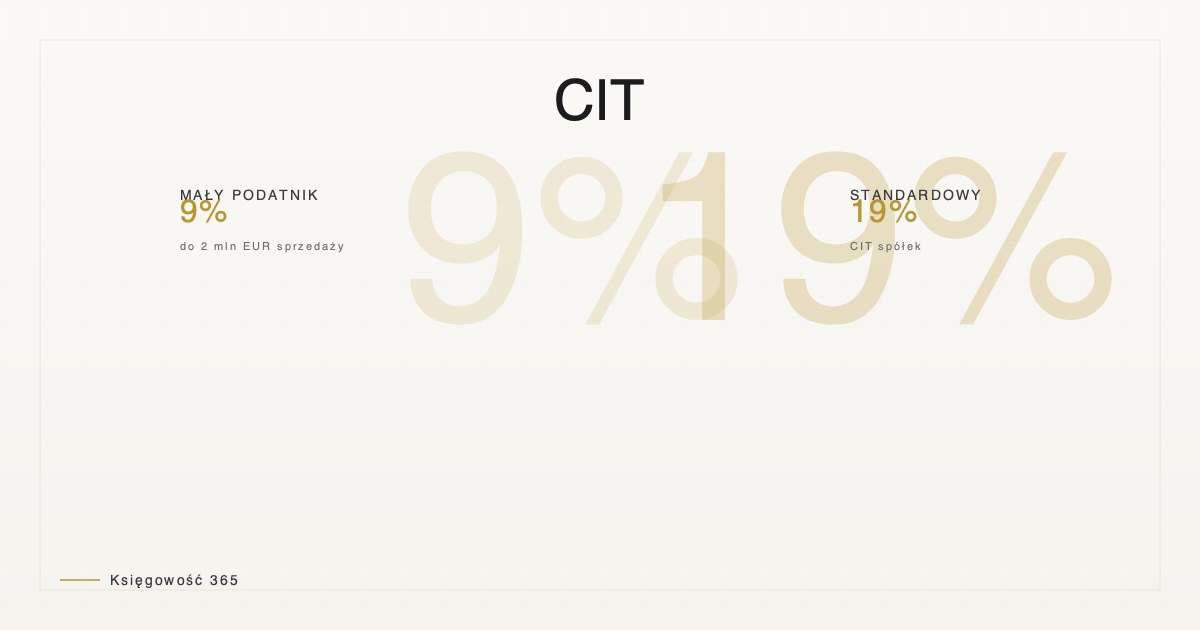
| Tax Rate | 19% annually (2026) | 10% on ordinary dividends, 20% on extraordinary |
| Profit Reinvestment | Tax immediately on profit | No tax — you pay only on distribution |
| Business Impact | Higher annual tax burden | Lower costs for growth — more capital available |
Example: if your company earns PLN 100,000:
- Standard CIT: tax will be PLN 19,000, leaving you with PLN 81,000 (and you decide whether to invest or distribute)
- Estonian CIT: if you keep the money in the company — tax will be PLN 0. You pay tax only when you distribute a dividend (10% = PLN 10,000)
Eligibility conditions and 2026 changes
From 2026, the conditions for accessing Estonian CIT have been significantly revised. The main condition — the revenue limit — has increased substantially.
Who can use Estonian CIT in 2026?
- LLC (Limited Liability Company)
- JSC (Joint-Stock Company)
- Annual revenue: up to PLN 2,000,000 (increased from previous limit of PLN 1,200,000)
- Maximum 50 shareholders
- Foreign entity shareholding: max 50% of capital
- Maintaining full accounting records
Important: If the company exceeds the revenue limit even for a single day in the tax year, it will have to resume taxation under standard CIT (with some exceptions).
Formal Requirements
To switch to Estonian CIT, the company must:
- File a statement of system choice with the tax office
- Choose the start date as January 1 of the given year (or for new companies — from the month of registration)
- Maintain an "equity account" — a special register to track retained earnings
- File an annual report in the form of Estonian CIT (dedicated form)
Tax rates and taxation mechanism
The Estonian CIT system is based on two tax rates:
10% — ordinary dividend
This rate applies to standard distribution of retained profit. Tax is calculated as follows:
- Retained profit in company × 10% = tax to pay
- Example: company earns PLN 100,000, pays no dividend — tax will be PLN 0. If next year it distributes PLN 50,000, tax will be PLN 5,000
20% — extraordinary dividend
This higher rate applies to:
- Distributions exceeding average profit from last 3 years (for shareholder holding over 50%)
- Company liquidation — then all retained profits are taxed at 20%
- Distributions in forms other than cash or assets (e.g., free use of company property)
0% — no tax on reinvestment
Key point: if profit is retained in the company and allocated to:
- Business expansion
- Purchase of new machinery and equipment
- Increase of working capital
- Payment of business obligations
— then there is no tax. You pay tax only on distribution.
Conditions for maintaining Estonian CIT
Switching to Estonian CIT is a long-term decision. To maintain this system, the company must meet specific conditions:
1. System Continuity
Once chosen, the system must be applied continuously. If the company fails to meet conditions in any year (e.g., exceeds revenue limit), it will be transferred to standard CIT and must wait minimum 3 years before choosing Estonian CIT again.
2. Accounting Records
The company must maintain full commercial books (not simplified accounting), particularly:
- "Equity account" — tracking of all retained earnings
- Register of distributed dividends with dates and amounts
- Annual financial statement
3. Revenue Limit
Annual revenue cannot exceed PLN 2,000,000. Revenue is counted gross, without VAT. If you exceed the limit, you will have to switch to standard CIT.
4. Shareholding Structure
Foreign entity shareholding in the company cannot exceed 50% of capital. If a foreign shareholder acquires more than 50%, the company will lose the right to Estonian CIT.
5. No Tax Predecessor
The company must be registered in Poland and cannot be a result of merger or division of another company on Estonian CIT (if that previous company applied Estonian CIT).
Practical benefits of Estonian CIT — calculation example
Company "TechBiz" LLC earns PLN 500,000 annually and plans investments. Let's compare financing investments under both systems:
Scenario 1: Standard CIT
- Gross profit: PLN 500,000
- CIT 19%: PLN 95,000 (tax paid to the state)
- Available net profit: PLN 405,000
- If the company wants to invest PLN 300,000 — must take from this net (or borrow)
- Remaining for owner: PLN 105,000
Scenario 2: Estonian CIT
- Gross profit: PLN 500,000
- Estonian CIT on reinvestment: PLN 0 (no tax!)
- Capital available for investment: PLN 500,000
- If the company invests PLN 300,000, tax will be PLN 0
- If it distributes dividend PLN 200,000: tax will be PLN 200,000 × 10% = PLN 20,000
Difference: with Estonian CIT the company has access to the full PLN 500,000 without tax, whereas with standard CIT — only PLN 405,000. This is a saving of PLN 95,000 in CIT (or additional capital for investments).
Pitfalls and risks of Estonian CIT
Despite the benefits, Estonian CIT has several serious limitations and risks you need to know:
1. Inability to exit without penalties
Once chosen, Estonian CIT can be abandoned, but:
- All retained earnings are taxed at 20% (extraordinary dividend)
- Must wait minimum 3 years before choosing Estonian CIT again
- Example: if the company retained PLN 300,000 profit, switching to standard CIT will require paying tax on PLN 300,000 × 20% = PLN 60,000
2. Tax on accumulated profit
Estonian CIT assumes profit is retained in the company. But if you want to:
- Distribute yourself a dividend — you pay 10% tax
- Distribute extraordinary dividend (above average) — you pay 20%
- Exit the company — tax will be 20% on all retained earnings
In practice: Estonian CIT is profitable only if profit stays in the company for a long time (2+ years).
3. Income tax on dividend for shareholder
Dividend distribution from Estonian CIT is subject to additional income tax:
- 19% income tax on shareholder (if a natural person)
- Example: if the company distributes PLN 100,000 dividend, Estonian CIT will be PLN 10,000, and shareholder income tax will be another PLN 19,000 (on the amount after CIT = PLN 90,000 × 19%)
4. Revenue limit time constraint
The PLN 2,000,000 revenue limit is strict. If the company grows quickly:
- Upon exceeding the limit — automatic switch to standard CIT
- No "transition period" — this happens immediately
- Must wait 3 years before choosing Estonian CIT again
5. Complex accounting records
The "equity account" requires precise monthly accounting. Errors can lead to:
- Invalidation of Estonian CIT choice retroactively
- Need to pay overdue taxes with interest
- Penalties from the tax office
Estonian CIT vs. PIT (for self-employed)
If you are a natural person running a business, you can choose between:
| System | Tax Rate | Best For |
|---|---|---|
| Estonian CIT | 0% on reinvestment, 10% on dividend | Growing companies, long-term reinvestment |
| Standard CIT | 19% annually | Stable companies, regular dividend distribution |
| PIT (self-employed) | 32% (18% PIT + 9% + health insurance) | Micro-businesses, simple operations |
Bottom line: If you plan to reinvest 70%+ of profits for 2+ years, Estonian CIT is likely worth it. If you need to distribute profits annually, standard CIT is simpler.
Frequently Asked Questions
Can I switch to Estonian CIT mid-year?
No. The switch must happen from January 1 of the tax year. For new companies, it can be from the month of registration. There's no mid-year switching option.
What if I exceed the revenue limit?
You automatically lose Estonian CIT status and are transferred to standard CIT. You must then wait 3 years before applying for Estonian CIT again. No exceptions, no appeals.
Can I distribute profit to myself without tax?
No. When you distribute a dividend, you pay 10% Estonian CIT. Additionally, as a natural person shareholder, you pay 19% income tax. Combined: approximately 28% total.
Is Estonian CIT worth it for a small company?
It depends on your reinvestment plans. If you reinvest 70%+ of profits for 2+ years, yes. If you need annual distributions, it's not worth the complexity.
What is the "equity account" and why do I need it?
The equity account is a register that tracks retained earnings under Estonian CIT. It shows how much profit is available for distribution without triggering the 20% extraordinary dividend rate. It's mandatory and checked by tax authorities.