VAT in 2026
— Complete Guide for Entrepreneurs
VAT is one of the most complex taxes to handle, yet one of the most fundamental for the Polish tax system. In this complete guide, I explain VAT mechanisms, applicable rates, registration procedures, deductions, and reporting requirements that every entrepreneur must understand in 2026. Based on 15 years of experience as a tax advisor.
What is VAT? Mechanisms and Fundamentals
Value Added Tax (VAT) is a form of tax on consumption, meaning it ultimately taxes the final consumer, while the state collects it at each stage of trade. This mechanism is one of the main sources of budget revenue in the European Union.
How the VAT mechanism works:
- Value addition principle — VAT applies only to the value added that a company creates, not the entire sales value
- Deductions — the company calculates output VAT (from revenues) and then deducts input VAT (from expenses)
- Settlement — the difference between output VAT and input VAT is transferred to the budget (or refunded)
Example: A manufacturer buys materials for 1,000 PLN (with 23% VAT = 230 PLN). Then sells the product for 2,000 PLN (with 23% VAT = 460 PLN). The manufacturer pays VAT to the budget: 460 - 230 = 230 PLN. The final consumer pays 460 PLN in VAT, but it is distributed across the stages of trade.
Poland, as a member of the European Union, complies with the EU VAT Directive (Directive 2006/112/EC). This means that while we have some flexibility in setting rates, we must comply with minimum EU standards.
VAT Registration — When Mandatory, When Voluntary?
Mandatory VAT Registration
You are obligated to register for VAT when you meet one of the following conditions:
- Revenue threshold — Your revenue from the sale of goods and services (excluding VAT-exempt sales) exceeds 240,000 PLN in a 12-month calendar period or 12 consecutive months
- Intra-EU transactions — You carry out deliveries of goods outside the EU or purchases of goods from the EU
- Import of goods — You import goods from outside the EU
- International services — You provide services to foreign taxpayers
- Excise tax obligation — You are subject to excise tax requirements (fuel, alcohol)
Important: The obligation to register arises from the first day of the following calendar month after exceeding the 240,000 PLN threshold. This means if you exceed the threshold in October, you will be registered from November 1st.
Voluntary VAT Registration
You can voluntarily register even if you do not meet mandatory conditions, if:
- You want to deduct input VAT from your purchases
- You want to increase your business credibility (VAT invoices assure your customers)
- You plan transactions with VAT taxpayers
However, voluntary registration also has consequences — you must maintain full documentation, submit periodic declarations, and your administrative burden generally increases.
Registration Procedure
VAT registration is done by submitting an application to the tax office, usually online. Required documents include:
- Certificate of entry in the CEIDG or KRS (business registry)
- PIT-8 form (for individuals) or appropriate certificate from the company
- Declaration regarding the intention to carry out deliveries of goods and services
The VAT number (NIP) is automatically assigned upon registration, usually within a few days.
VAT Rates in 2026 — Practical Application
In 2026, the following VAT rates apply:
| Rate | Percent | Examples of goods/services |
|---|---|---|
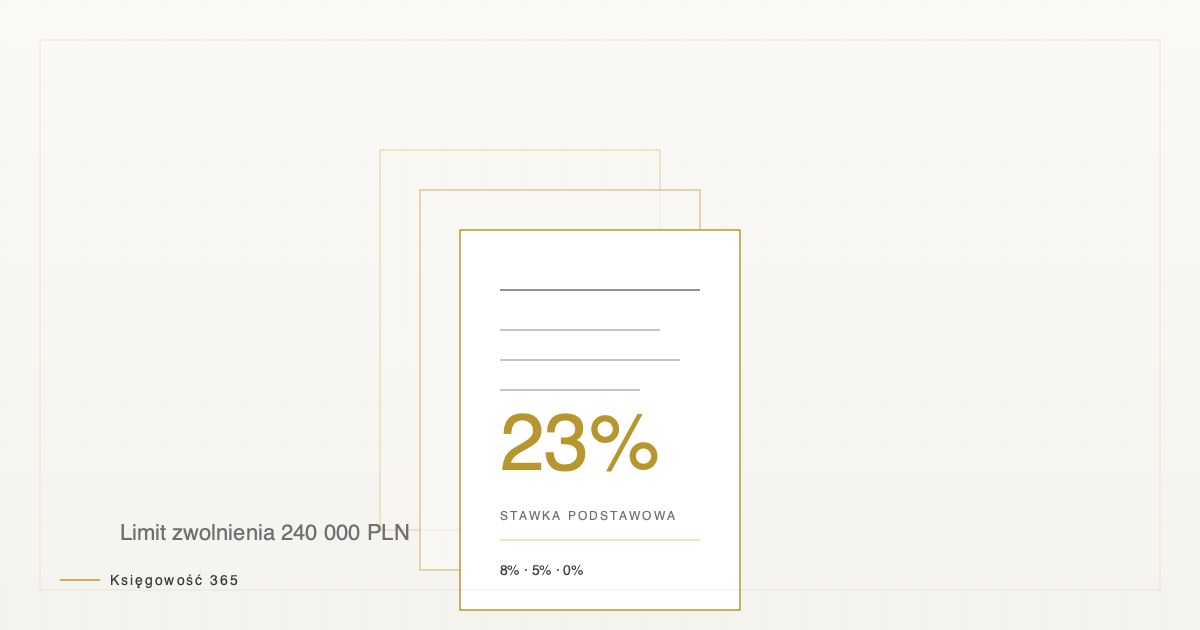
| Standard rate | 23% | Most goods and services: electronics, clothing, consulting services, space rentals, restaurants, hotels |
| Reduced rate I | 8% | Food (with certain exceptions), medicines, books, tobacco, fuel, electricity for households |
| Reduced rate II | 5% | Basic food products: bread, milk, confectionery, meat, fish, vegetables |
| Zero rate | 0% | Export of goods, international transport services, financial services (in part), published newspapers |
| VAT exemption | no tax | Medical services, educational services, credit services, insurance, residential property rentals |
Key Principles for Rate Application
1. The nature of the goods or services determines the rate — not the qualifications of the seller, but what you are selling. For example, if you sell bread, it is always 5%, regardless of whether you are a bakery or a supermarket.
2. The date of sale determines the rate — if the rate changes, the one that was current at the time of sale (invoice date) applies.
3. Accuracy matters — incorrect rate application is one of the most common reasons for tax authority observations. Always verify that you classify goods/services correctly.
JPK_VAT — New Requirements and Deadlines
JPK_VAT (Unified Control File) is the electronic VAT declaration that every taxpayer must submit monthly (or quarterly in selected cases). As of 2026, the procedure is changing and becoming more restrictive.
Reporting Frequency and Deadlines
- Active VAT taxpayers — file JPK_VAT monthly by the 25th of the following month
- Taxpayers with revenue up to 240,000 PLN annually — may file JPK_VAT quarterly (but this is optional, not mandatory)
- Electronic submission — JPK_VAT must be submitted exclusively electronically via the Internet, paper submission is no longer available
JPK_VAT Contents
JPK_VAT must include:
- Taxpayer data (NIP, name, address)
- Data on deliveries of goods and provision of services (broken down by VAT rate)
- Data on acquisition of goods and services (broken down by VAT rate)
- Intra-EU data (deliveries, acquisitions)
- Export and import data
- Summary of input VAT, output VAT, and amount to pay/refund
Technical Requirements
JPK_VAT must be submitted in XML format or via modules available on the tax portal (podatki.gov.pl). The file must comply with the XSD schema published by the Ministry of Finance.
Many accounting software programs (Wapro, Comarch, Enova, Sage) already have integrations for automatic JPK_VAT generation and submission. Check if your software supports this functionality.
Split Payment — Mechanism of Divided Payment
What is Split Payment?
Split payment (divided payment mechanism) is a system where VAT from a transaction is automatically transferred to the budget by the bank, instead of being paid by the buyer. The purpose is to combat VAT fraud and tax evasion.
When is Split Payment Mandatory?
Divided payment is mandatory for transactions meeting both conditions:
- The invoice value exceeds 15,000 PLN net, AND
- The invoice concerns goods or services from a high-risk list (sensitive sectors)
High-risk goods and services include:
- Fuels (gasoline, diesel, LPG gas)
- Electronics (processors, chips, electronic components)
- Metals (copper, gold, platinum)
- Wood
- Clothing and footwear
- Mobile phones
- Vehicle spare parts
Example: You purchase fuel for 30,000 PLN net (approximately 37,000 PLN gross). The invoice value (net) exceeds 15,000 PLN and concerns fuel — split payment is mandatory. VAT automatically goes to the budget, and you pay only the net portion to the supplier.
Consequences for the Buyer
If you are a buyer in a split payment transaction:
- You pay the net portion to the supplier as usual
- VAT goes automatically to the budget through the banking system (or a special account)
- You can deduct VAT from this invoice like any other invoice
- The procedure is handled by your bank — you do not need to do anything additional
Consequences for the Seller
If you are a seller:
- You must have a special settlement account for split payment with your bank
- VAT from the invoice will not be transferred to you by the buyer — it automatically goes to the budget
- You must show output VAT in JPK_VAT, but you will not actually collect it from the buyer
- Your bank handles the automatic transfer of VAT to the budget
VAT Deductions — What Can You Deduct?
Input VAT deduction is one of the key mechanisms allowing companies to reduce their tax burden. However, not all VAT can be deducted — there are specific rules and limitations.
What Can Be Deducted?
You can deduct VAT from invoices for:
- Goods and materials — purchased for conducting taxable business activity (materials, raw materials, components)
- Services — consulting, marketing, advertising, accounting (when related to business operations)
- Fixed assets — machinery, equipment, vehicles (with limitations)
- Energy — electricity, gas, heating (partially, depending on use)
- Fuel — for business vehicles (not for private use)
What Cannot Be Deducted?
Input VAT cannot be deducted from:
- Personal vehicle purchases — unless registered as a business vehicle
- Meals and hospitality — restaurant bills, catering, accommodation (with certain exceptions)
- Private fuel consumption — fuel not used for business purposes
- VAT-exempt supplies — financial services, insurance, certain rentals
- Goods destroyed or lost — without proper documentation
- Incomplete invoices — missing required data or not properly issued
Invoice Requirements for Deduction
To deduct VAT, the invoice must contain:
- Complete identification data of seller and buyer (company name, NIP, address)
- Invoice number, issue date, and delivery date
- Detailed description of goods or services
- Unit price and quantity
- Net amount, VAT amount, and gross amount
- VAT rate applied
- Seller's VAT identification number
VAT in International Transactions
Trading with foreign contractors requires special attention to VAT regulations. The rules differ depending on whether your partner is in the EU or outside.
Intra-EU Transactions
Deliveries to the EU (exports within the EU): These are charged at 0% VAT (zero-rated) if the buyer is a VAT-registered entrepreneur and the conditions of intra-community supply are met. This requires proper documentation (invoice with buyer's VAT number).
Acquisitions from the EU (imports within the EU): When you purchase goods from an EU supplier, VAT is not charged by the supplier. Instead, you are liable for VAT (reverse charge), which means you both pay and deduct VAT yourself in your VAT settlement.
Services from abroad: For services provided by non-EU suppliers, the place of taxation is determined by the recipient's location and the nature of the service. VAT is usually charged under reverse charge rules.
Transactions with Non-EU Countries
Exports outside the EU: These are zero-rated. Documentation requirements include customs declarations and proof of export (shipping documents, proof of delivery).
Imports from outside the EU: When importing goods, you must pay VAT at the Polish rate, calculated on the value of goods plus duties and transport costs. Import VAT is deductible if the goods are intended for business purposes.
Common VAT Mistakes to Avoid
Based on years of experience working with companies, I can identify the most common VAT errors:
1. Incorrect rate classification — Applying 23% instead of 8% or 5% is one of the most frequent mistakes. Always verify the correct rate in the product classification table.
2. Incomplete invoices — Missing buyer identification data or incorrect VAT number entry. The tax authority will not accept such invoices for deduction.
3. Deducting VAT from non-deductible items — Many companies try to deduct VAT from meals or personal vehicles, which is not allowed.
4. Missing proof of delivery — For intra-EU sales at 0% VAT, you need clear documentation proving the goods were delivered outside Poland.
5. Late JPK_VAT filing — Even a single day late can result in penalties. Set calendar reminders for the 25th of each month.
6. Incorrect reverse charge handling — When acquiring services from abroad, many companies forget to calculate and report the reverse charge correctly.
7. Not updating to current rates — Using old rate tables instead of checking the current rates, especially when purchasing goods from new suppliers.
Summary
VAT is a complex tax, but understanding the basics will help you avoid costly mistakes. The key points to remember:
- Register for VAT when you exceed 240,000 PLN in revenue
- Learn the four standard rates and how to apply them correctly
- Always maintain complete and correct invoices
- File your JPK_VAT by the 25th of each month
- Keep split payment rules in mind for high-value transactions
- Be careful with international transactions — reverse charge rules apply
- Document everything and keep records for at least 5 years
If you are unsure about any aspect of VAT compliance, consider consulting with a tax advisor. A small investment in proper tax advice can save you thousands in potential penalties.