Employee Payroll Costs in 2026
How Much Does an Employee Really Cost?
Before hiring an employee, employers must understand the real cost. Gross salary is only part of the expenses. Beyond salary, employers pay substantial social security contributions that significantly increase the total cost of employment. In this guide, I explain how to calculate the actual costs, break down all contributions, and provide practical examples for 2026.
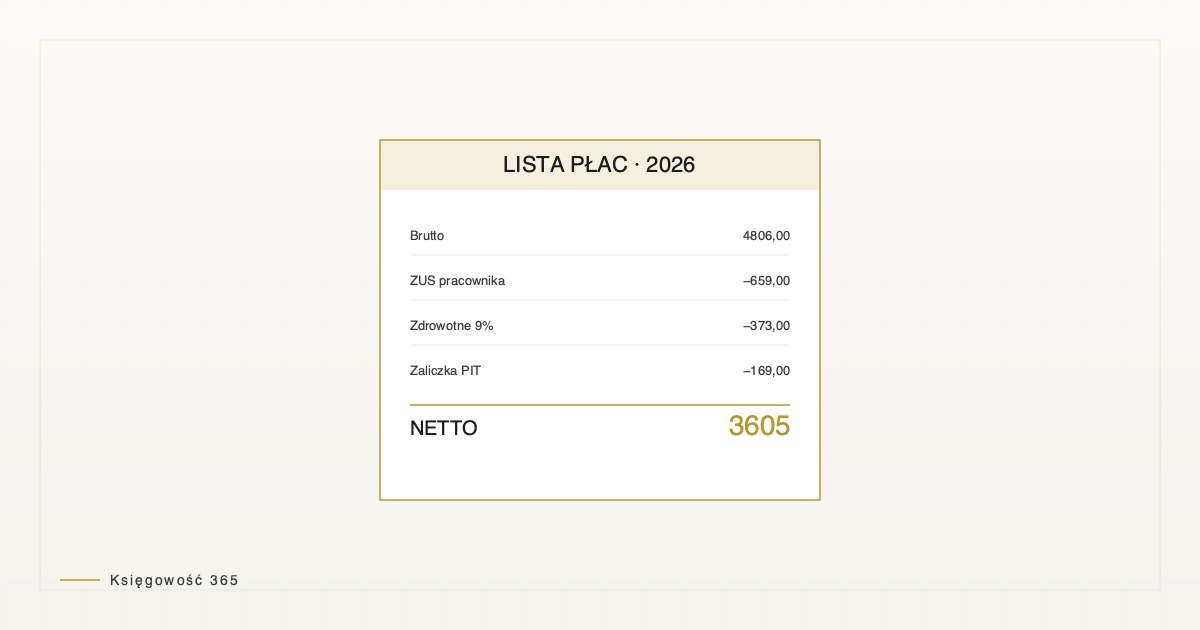
How Much Does an Employee Really Cost? Total Employment Cost
Beyond gross salary, employers bear additional costs for social security and labor fund contributions. Employee cost is approximately 20–22% above gross salary (excluding voluntary pension plans).
Using 2026 minimum wage (4,806 PLN gross) as an example, real employer cost is 5,862 PLN. To pay an employee 5,000 PLN net, the employer must spend significantly more than the gross salary.
This hidden cost often surprises employers when first reviewing their payroll budgets. It's essential to understand and budget for these additional expenses when planning hiring.
Minimum Wage in 2026: Gross and Total Cost
Effective January 1, 2026, new minimum wage applies in Poland. Understanding this baseline is crucial for any employer.
| Parameter | Amount |
|---|---|
| Minimum gross monthly salary | 4,806.00 PLN |
| Minimum hourly rate | 31.40 PLN |
| Employer's total cost for minimum wage | 5,862.37 PLN |
| Difference (employer pays above salary) | 1,056.37 PLN (21.98%) |
This means even at minimum wage, the real cost to the employer is nearly 22% higher than what appears in the salary budget.
Components of Employee Costs: Detailed Breakdown
Employee costs consist of two main parts: deductions from the employee's salary and contributions paid directly by the employer.
What Gets Deducted from Employee Salary
Employees never see these amounts in their paychecks — they're deducted before net salary is paid:
| Type of Deduction | Rate in 2026 | Purpose |
|---|---|---|
| Retirement (Pension) Contribution | 9.76% | Mandatory retirement insurance |
| Disability Insurance | 1.5% | Protection against disability |
| Sickness Insurance | 2.45% | Coverage for sick leave |
| Health Insurance (NFZ) | 9% | National Health Fund contribution |
| Income Tax (PIT) | 12% or 32% | Progressive income tax |
| Total Employee Deductions | ~34.71% | Combined mandatory deductions |
What Employer Pays (Not Deducted from Employee)
These are additional costs employers pay directly to social security and government funds:
| Type of Contribution | Rate in 2026 | Purpose |
|---|---|---|
| Retirement Contribution | 9.76% | Employer's share of retirement |
| Disability Insurance | 6.5% | Employer's disability coverage |
| Accident Insurance | 0.67% – 3.33% | Varies by industry risk level |
| Labor Fund (FP) | 2.45% | Employment support fund |
| Guaranteed Benefits Fund (FGŚP) | 0.10% | Employee protection fund |
| Bridge Pensions Fund (FEP) | 1.5% | Early retirement bridge |
| Total Employer Contributions | ≈21.98% | Combined employer obligations |
Practical Cost Breakdown: 5,000 PLN Gross Salary
Let's calculate the exact costs for a typical 5,000 PLN gross salary in 2026.
| Item | Amount (PLN) | Notes |
|---|---|---|
| GROSS SALARY (What's in the contract) | ||
| Gross Monthly Salary | 5,000.00 | Base salary from contract |
| EMPLOYEE DEDUCTIONS (Taken from gross) | ||
| Retirement Contribution (9.76%) | -488.00 | Goes to retirement account |
| Disability Insurance (1.5%) | -75.00 | Social insurance |
| Sickness Insurance (2.45%) | -122.50 | Social insurance |
| Subtotal After Social Security | 4,314.50 | Base for health/tax |
| Health Insurance (9% on subtotal) | -388.31 | National Health Fund |
| Taxable Base | 3,926.19 | Used for tax calculation |
| Income Tax (12% first bracket) | -471.14 | PIT deduction |
| NET SALARY (What employee receives) | ||
| Net Monthly Salary to Employee | 3,455.05 | This goes to employee's bank |
| EMPLOYER ADDITIONAL COSTS (Paid by employer only) | ||
| Employer Retirement (9.76%) | +488.00 | Employer's share |
| Employer Disability (6.5%) | +325.00 | Employer's share |
| Accident Insurance (0.67% example) | +33.50 | Varies by industry |
| Labor Fund (2.45%) | +122.50 | Employer's share |
| Guaranteed Benefits Fund (0.10%) | +5.00 | Employer's share |
| Bridge Pensions Fund (1.5%) | +75.00 | Employer's share |
| TOTAL EMPLOYER COST | ||
| Total Cost to Employer | 6,049.00 | Gross + employer contributions |
| Markup on Gross Salary | +1,049.00 (+20.98%) | Real cost of employment |
This detailed breakdown shows why employers must budget approximately 21% more than the gross salary to account for their mandatory contributions.
2026 Tax and Contribution Reliefs for Employers
Several categories of employees qualify for reduced employer contributions in 2026. Understanding these reliefs can significantly reduce employment costs.
Employees Under 26 (First Employment Period)
Young workers benefit from a temporary relief for the first 12 months of employment:
- Relief from Labor Fund contribution: 2.45%
- This reduces employer costs by approximately 122.50 PLN per 5,000 PLN salary
- Significant savings for employers hiring youth
Employees Over 60
Older workers also receive relief to encourage their continued employment:
- Relief from Labor Fund contribution: 2.45%
- Plus potential relief from other contributions depending on region
- Additional incentive for retaining experienced staff
Disabled Employees
Significant reliefs apply for employers hiring employees with disabilities:
- 50% relief on most contributions (50-90% depending on disability grade)
- Substantial cost reduction: from 1,049 PLN to 525-525 PLN in employer costs
- Equal opportunity employment incentive
Regional Support Programs
Government programs support employment in economically disadvantaged regions:
- 30-80% relief on employer contributions depending on region
- Aimed at supporting economic development in specific areas
- Consult with local employment office for eligibility
Employment Types: Cost Comparison
Different employment arrangements have significantly different cost implications for employers.
| Employment Type | Estimated Employer Cost | Key Characteristics |
|---|---|---|
| Full-Time Employment | 6,000 + ~1,319 = 7,319 PLN (for 6,000 revenue) | Mandatory contributions ~22%, full legal obligations, employee protections |
| B2B Contract (Self-Employed) | 6,000 PLN (invoice net) | No employer contributions, contractor handles own insurance, higher flexibility |
| Freelance Contract | 6,000 + ~180 = 6,180 PLN (3% disability only) | Minimal employer responsibility, no retirement contributions, suitable for project work |
Important: B2B contracts are cheaper for employers but provide less employee protection. Full-time employment creates stronger legal relationships and employee benefits.
How to Calculate Employee Cost: Practical Calculator
Use this simple formula to calculate the total cost of any employee:
Basic Formula
Total Cost = Gross Salary × 1.2198
Step-by-Step Calculation
Step 1: Determine Gross Salary
Example: 5,000 PLN monthly
Step 2: Calculate Employer Contributions
Employer Social Security = Gross Salary × 21.98%
Example: 5,000 × 0.2198 = 1,099 PLN
Step 3: Sum Total Cost
Total Cost = Gross Salary + Employer Contributions
Example: 5,000 + 1,099 = 6,099 PLN
Quick Reference Table
| Gross Salary | Employer Contributions (~21.98%) | Total Employer Cost |
|---|---|---|
| 3,000 PLN | 659 PLN | 3,659 PLN |
| 4,806 PLN (minimum) | 1,056 PLN | 5,862 PLN |
| 5,000 PLN | 1,099 PLN | 6,099 PLN |
| 6,000 PLN | 1,319 PLN | 7,319 PLN |
| 8,000 PLN | 1,758 PLN | 9,758 PLN |
| 10,000 PLN | 2,198 PLN | 12,198 PLN |
Additional Employment Costs Beyond Salary
Beyond social security contributions, employers may face additional costs depending on employment type and industry:
Mandatory Costs
- Medical examinations: Required checkups (200-500 PLN annually) for health and safety compliance
- Occupational safety training: Required in many industries (100-300 PLN annually)
- Safety certifications: Industry-specific training and certificates
Optional but Common Costs
- Work uniforms: Required in some industries (500-2,000 PLN annually)
- Professional development: Training and education programs
- Health insurance supplements: Additional private insurance options
- Pension plan supplements: Employee Pension Plan (PPK) contributions
Frequently Asked Questions
Does the hourly minimum wage affect employer costs?
Yes, indirectly. The minimum hourly rate (31.40 PLN in 2026) is calculated from minimum monthly salary. Employers still pay approximately 22% in contributions regardless of whether payments are monthly or hourly.
Can I reduce costs by paying below minimum wage?
No, paying below minimum wage is illegal in Poland. Any salary must meet the minimum wage requirement. The only alternative to reduce costs is to use contractor or freelance arrangements, which change the employment relationship entirely.
What happens if an employer doesn't pay social security?
Failure to pay mandatory social security is serious. Penalties include: fines up to 2,000 PLN daily, employee lawsuit rights, potential criminal prosecution, and audits triggering additional penalties. Social security is mandatory and strictly monitored.
Do employees see employer contributions on their payslip?
No. Employees see only their net salary on the payslip. Employer contributions appear in employer's accounting records and social insurance reports, not on employee documentation.
Is there a way to avoid social security payments?
Not for full-time employees. Social security contributions are mandatory for all employment contracts. The only alternative is to completely change the employment relationship (e.g., B2B contract makes the contractor responsible for their own insurance).
About the Author
Katarzyna Zielińska
Age: 34 years
Education: Master of Laws with specialization in labor law (Jagiellonian University)
Experience: 10 years in payroll, human resources, and employment law consulting
Specialist in practical HR matters: payroll calculation, social benefits optimization, employment cost planning. Has conducted over 500 HR training sessions for Polish companies and regularly updates materials on regulatory changes.