Flat-rate Tax vs. Simplified Bookkeeping
2026 Comparison and Recommendations
Choosing between flat-rate tax and simplified bookkeeping (KPiR) is one of the most important decisions for a new entrepreneur. Both methods are popular, but they work in completely different ways. With 14 years of experience in business taxation, I can say that most entrepreneurs choose incorrectly simply because they don't understand the differences. In this guide, I explain the advantages and disadvantages of each method, provide detailed calculations, and help you make the right choice for your specific situation.
What's the Difference Between Flat-rate Tax and Simplified Bookkeeping?
These are two fundamentally different taxation systems:
Flat-rate Tax — A Fixed Percentage on Revenue
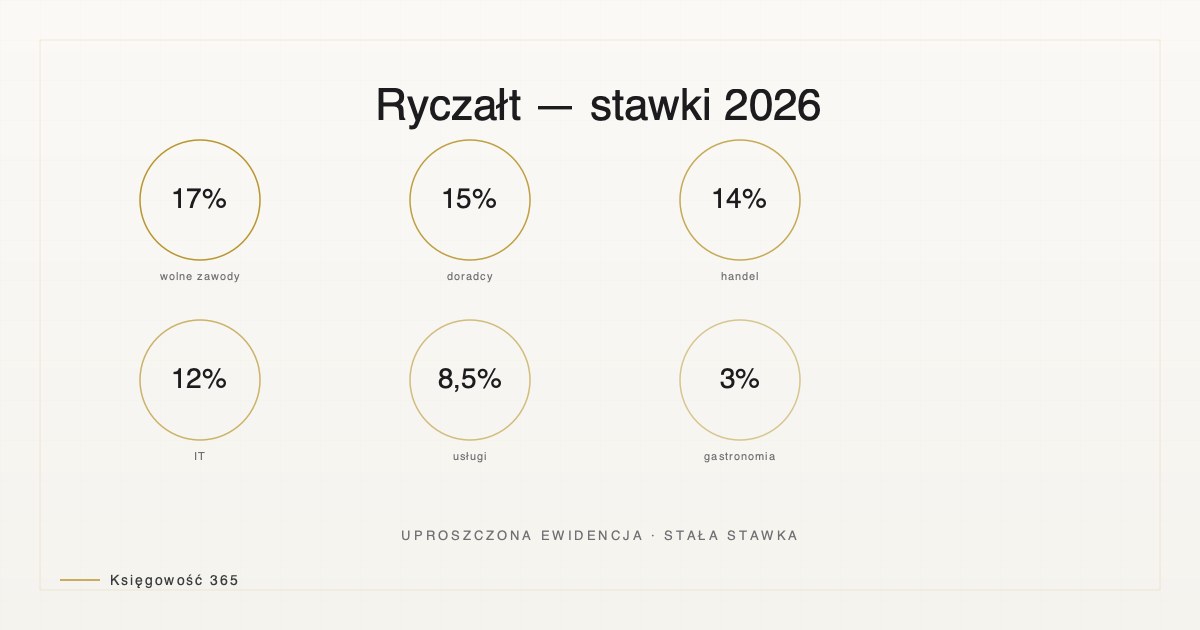
Flat-rate tax is a simplified income tax system. You pay a fixed percentage of your total revenue, regardless of your actual costs. The percentage varies by profession (2% to 17%).
Example: If you're on 12% flat-rate tax with 100,000 PLN revenue, you pay exactly 12,000 PLN in tax — even if your costs were 50,000 PLN or just 5,000 PLN.
Simplified Bookkeeping (KPiR) — Profit-based Taxation
Simplified bookkeeping is a system where you record all revenues and costs, then pay tax on the profit (revenue minus costs). The tax rate is progressive: from 12% to 32% depending on income level.
Example: With 100,000 PLN revenue and 50,000 PLN costs, your profit is 50,000 PLN, and you pay tax based on this lower amount.
Head-to-Head Comparison: Flat-rate vs. KPiR
| Aspect | Flat-rate Tax | Simplified Bookkeeping (KPiR) |
|---|---|---|
| Tax Calculation | Fixed % of revenue | Progressive tax on profit |
| Cost Deduction | No deduction — pay on total revenue | Full cost deduction |
| Record-keeping | Simple revenue register | Revenue and cost records (JPK) |
| Reporting Complexity | Very simple | Moderate complexity |
| Revenue Limit | 2,000,000 EUR | 10.6 million PLN |
| ZUS Contributions | Standard | Standard or reduced |
| Best For | Low-cost services | High-cost businesses |
When to Choose Flat-rate Tax
Flat-rate Tax Is Better If:
- Your costs are very low (under 10% of revenue)
- You want maximum simplicity in record-keeping
- You're a consultant, coach, or freelancer with minimal expenses
- You want predictable fixed tax payments
- You have high-margin services (software, training, writing)
Flat-rate Tax Calculation Example:
Service Business (IT Consulting)
Revenue: 120,000 PLN
Costs: 8,000 PLN (minimal)
Flat-rate: 12%
Tax: 14,400 PLN
ZUS: ~7,200 PLN (standard)
Total: 21,600 PLN
Net profit: ~98,400 PLN
When to Choose Simplified Bookkeeping (KPiR)
Simplified Bookkeeping Is Better If:
- Your costs are substantial (over 20% of revenue)
- You buy materials or inventory
- You have significant operational expenses (rent, utilities, supplies)
- You plan to grow the business substantially
- You need detailed financial records for loans or investors
Simplified Bookkeeping Calculation Example:
Trade/Production Business
Revenue: 120,000 PLN
Materials: 60,000 PLN
Labor: 15,000 PLN
Rent/utilities: 6,000 PLN
Total costs: 81,000 PLN
Profit: 39,000 PLN
Tax (12-32%): ~7,000 PLN
ZUS: ~7,200 PLN
Total: ~14,200 PLN
Net profit: ~24,800 PLN
Direct Cost Comparison
Low-Cost Business (Professional Services)
Revenue: 100,000 PLN, Costs: 5,000 PLN
| System | Calculation | Total Tax & ZUS |
|---|---|---|
| Flat-rate (12%) | 100,000 × 12% = 12,000 + 7,200 ZUS | 19,200 PLN |
| KPiR | (100,000 – 5,000) × 12% = 11,400 + 7,200 ZUS | 18,600 PLN |
| Difference | Flat-rate pays 600 more | KPiR better by 600 PLN |
High-Cost Business (Trade/Retail)
Revenue: 100,000 PLN, Costs: 60,000 PLN
| System | Calculation | Total Tax & ZUS |
|---|---|---|
| Flat-rate (12%) | 100,000 × 12% = 12,000 + 7,200 ZUS | 19,200 PLN |
| KPiR | (100,000 – 60,000) × 12% = 4,800 + 7,200 ZUS | 12,000 PLN |
| Difference | KPiR saves 7,200 PLN annually | KPiR better by 7,200 PLN |
Record-keeping Obligations
Flat-rate Tax Obligations:
- Maintain a simple revenue register (can be manual or in accounting software)
- Record every transaction (revenue entry)
- File PIT-36 or PIT-37 annually
- File monthly/quarterly VAT declarations if registered for VAT
- No cost tracking required (but keep receipts for 5 years)
Simplified Bookkeeping (KPiR) Obligations:
- Maintain revenue register
- Maintain cost register
- File JPK-PK (simplified bookkeeping report) monthly/quarterly
- File PIT-36 or PIT-37 annually with schedule KPiR
- Keep all receipts and cost documentation for 5 years
- Track asset depreciation if applicable
Revenue Limits for 2026
Flat-rate Tax Limit:
Maximum annual revenue: 2,000,000 EUR (approx. 8.6 million PLN)
If you exceed this limit, you must switch to another taxation method (KPiR or full accounting).
Simplified Bookkeeping (KPiR) Limit:
Maximum annual revenue: 10.6 million PLN
Above this, you must switch to full accounting.
Switching Between Systems
From Flat-rate to KPiR:
You can switch from flat-rate to simplified bookkeeping at the start of any tax year. The decision should be made before January 1st. It's not recommended to switch during the year.
From KPiR to Flat-rate:
Switching from KPiR to flat-rate is allowed, but only if your revenues from the previous year did not exceed the flat-rate limit (2,000,000 EUR).
ZUS Contributions Differences
ZUS contributions are similar under both systems. However, simplified bookkeeping opens the possibility of reduced ZUS contributions (Mały ZUS Plus) if your profit is lower.
| Contribution Type | Flat-rate | KPiR |
|---|---|---|
| Standard ZUS (full) | ~7,200 PLN/month | ~7,200 PLN/month |
| Mały ZUS (small) | Not available | ~970 PLN/month (if profit under 120k) |
| Mały ZUS Plus | Not available | ~1,270 PLN/month (if revenue under 300k) |
FAQ — Frequently Asked Questions
Can I start on flat-rate and then switch to KPiR?
Yes. Many entrepreneurs start with flat-rate for simplicity, then switch to KPiR when costs increase. The switch happens at the beginning of a calendar year.
Which system requires more record-keeping?
Simplified bookkeeping (KPiR) requires more detailed records. You must track both revenue and costs. Flat-rate requires only revenue recording.
Can I use accounting software for both systems?
Yes. Most accounting software supports both systems and can automatically switch between them.
Which system is better for getting a business loan?
Banks often prefer simplified bookkeeping because it shows detailed financial records. Flat-rate tax, while simpler, provides less financial transparency.
Do I need to keep receipts under flat-rate tax?
Yes, you must keep all business receipts for 5 years. While costs aren't deducted for flat-rate tax, you need documentation in case of tax authority audit.
Anna Wiśniewska
Age: 38
Education: Master's degree in Finance from the University of Warsaw
Experience: 14 years in tax consulting and business advisory
Anna specializes in taxation methods for small and medium-sized enterprises. She helps entrepreneurs choose the optimal accounting system and optimize their tax obligations. She is a regular speaker at business seminars and author of numerous articles on taxation.
Related Articles
Flat-rate Tax and VAT — Can a Flat-rate Payer Be a VAT Payer?
Combining flat-rate tax with VAT: rules, obligations, and when it's beneficial.
Flat-rate Tax Rates 2026 — Complete Table
Full table of flat-rate tax rates by profession and revenue limits.
ZUS Contributions 2026 — Full Table
Complete ZUS contribution amounts and comparison of contribution options.