Flat-rate Tax 2026
Complete Table of Rates, Limits, and Guidelines
The flat-rate tax (ryczałt ewidencjonowany) remains one of the most popular taxation methods for entrepreneurs in Poland. In 2026, the rates range from 2% to 17%, depending on the type of activity. This comprehensive guide provides a complete table of all rates by professional category, explains the revenue limits, and helps you determine if flat-rate tax is right for your business. With 14 years of tax experience, I've guided hundreds of entrepreneurs through this decision.
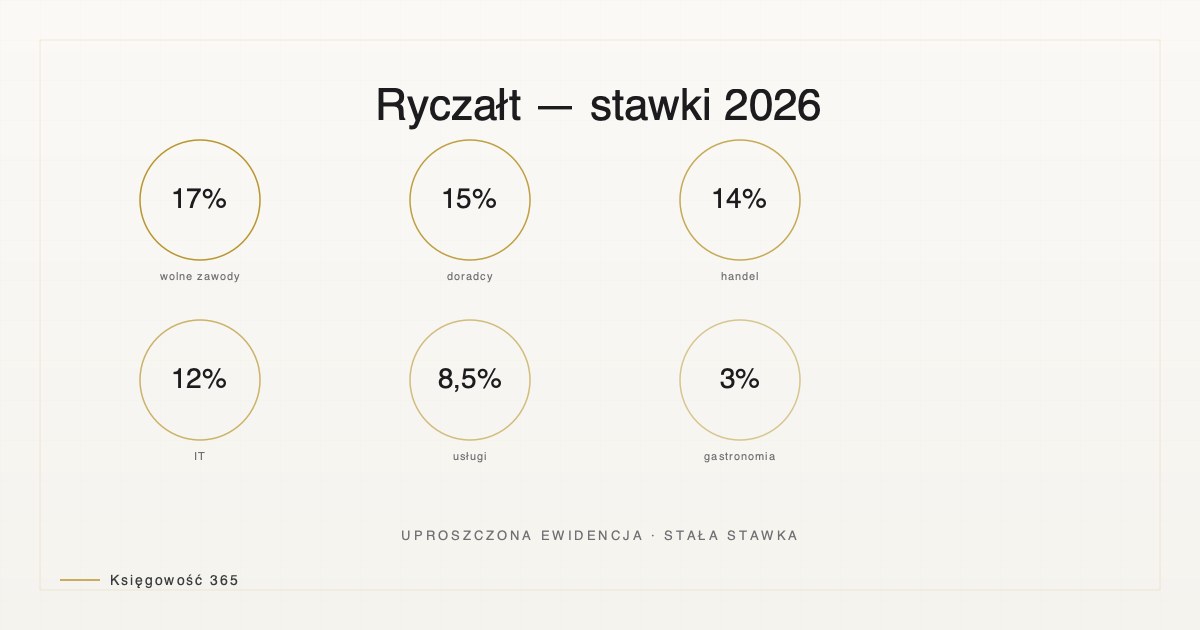
Complete Table of Flat-rate Tax Rates 2026
| Business Category | Rate | Examples |
|---|---|---|
| Agriculture, forestry, fishing | 2% | Farms, forests, beekeeping |
| Transport services (road) | 3% | Taxi, freight, courier |
| Services to agriculture | 4% | Farm supplies, veterinary |
| Construction services | 8% | Carpentry, plumbing, electrical |
| Manufacturing and crafts | 8% | Tailoring, hairdressing, repairs |
| Services (general) | 12% | Consulting, IT, education, training |
| Trade (retail) | 14% | Shops, online stores, wholesale |
| Financial and insurance services | 17% | Financial advisory, insurance brokerage |
Revenue Limit for Flat-rate Tax — 2,000,000 EUR
The fundamental limit for all flat-rate taxpayers is: 2,000,000 EUR annual revenue from the prior year.
How the Limit Works:
- In 2025, if your revenue does not exceed 2,000,000 EUR, you can apply flat-rate tax for 2026
- If you exceed this limit in any year, you must switch to another taxation method (simplified bookkeeping or full accounting) for the next year
- The limit is calculated in EUR using the National Bank of Poland exchange rate from October 2025
2026 Equivalent:
2,000,000 EUR equals approximately 8.6 million PLN (at average exchange rates).
Who Can Use Flat-rate Tax?
Eligible Entrepreneurs:
- Individual entrepreneurs (self-employed)
- Sole proprietors
- Farmers applying the flat-rate method
- Freelancers and consultants
Cannot Use Flat-rate Tax:
- Limited liability companies (Sp. z o.o.)
- Joint-stock companies (S.A.)
- Partnerships
- Other legal entities
Characteristics of Flat-rate Taxation
Advantages:
- Simplicity: No need to track costs; pay fixed percentage of revenue
- Predictability: You know exact tax amount based on revenue
- Speed: No complex accounting or bookkeeping required
- Transparency: Tax authority sees clear revenue-tax relationship
- Low administrative burden: Minimal record-keeping
Disadvantages:
- No cost deduction: You pay tax on full revenue, not profit
- Higher tax for high-cost businesses: Penalty for businesses with substantial expenses
- Revenue limit: Cannot grow beyond 2,000,000 EUR annually
- Less financial transparency: Difficult to obtain business loans or investor interest
Practical Examples
Example 1: IT Consultant (12% rate)
Annual revenue: 100,000 PLN
Tax: 100,000 × 12% = 12,000 PLN
ZUS: ~7,200 PLN
Total obligations: 19,200 PLN
Benefit: Simple accounting, no cost tracking
Example 2: Construction Company (8% rate)
Annual revenue: 500,000 PLN
Materials costs: 300,000 PLN (not deductible)
Tax: 500,000 × 8% = 40,000 PLN
ZUS: ~7,200 PLN
Total: 47,200 PLN (vs. ~40,000 on simplified bookkeeping)
Example 3: Retail Shop (14% rate)
Annual revenue: 250,000 PLN
Tax: 250,000 × 14% = 35,000 PLN
ZUS: ~7,200 PLN
Total: 42,200 PLN
When to Choose Flat-rate Tax
Best For:
- Service businesses with minimal material costs
- Consulting, coaching, training, freelance professionals
- Software developers, designers, writers with high margins
- Entrepreneurs who want maximum simplicity
- Businesses expecting to stay below 2,000,000 EUR revenue
Not Recommended For:
- Manufacturing or production businesses with high material costs
- Wholesale or trade with significant inventory costs
- Growing businesses planning to exceed revenue limits
- Entrepreneurs needing detailed financial statements for loans
Switching Taxation Methods
From Flat-rate to Simplified Bookkeeping:
You can switch at the beginning of any calendar year. The decision should be communicated to the tax authority by January 1st.
From Simplified Bookkeeping to Flat-rate:
Allowed only if your prior-year revenue did not exceed 2,000,000 EUR.
FAQ
Do I pay VAT under flat-rate tax?
Flat-rate tax and VAT are independent. You can be on flat-rate and either VAT-exempt (up to 240,000 PLN revenue) or actively registered for VAT.
Can I deduct any expenses from flat-rate tax?
No. Flat-rate tax is calculated on gross revenue. However, you must still keep business receipts for 5 years in case of audit.
What if I exceed the 2,000,000 EUR limit?
You must switch to simplified bookkeeping or full accounting for the next tax year. This is not optional.
Can flat-rate payers use reduced ZUS?
No. Flat-rate taxpayers typically pay standard ZUS contributions. Reduced ZUS (Mały ZUS) is available only for simplified bookkeeping.
Which form do I file for flat-rate tax?
You file PIT-36 or PIT-37 (depending on employment status) with schedule for flat-rate tax income.
Anna Wiśniewska
Age: 38
Education: Master's degree in Finance, University of Warsaw
Experience: 14 years in tax consulting and business advisory
Anna helps entrepreneurs choose the optimal taxation method and understand tax regulations. She specializes in small business taxation and cost optimization.
Related Articles
Flat-rate vs. Simplified Bookkeeping 2026
Detailed comparison to help you choose the right taxation method.
Flat-rate Tax and VAT
Can you combine flat-rate with VAT registration? Complete guide.
ZUS Contributions 2026 — Full Table
Complete ZUS contribution amounts for self-employed entrepreneurs.