Income Tax in 2026
PIT and CIT, Complete Guide
Income tax is one of the fundamental obligations for every entrepreneur and individual in Poland. In 2026, the tax system remains unchanged in its core principles, but it's worth thoroughly understanding the differences between PIT and CIT, available credits, and optimal solutions for your situation. As a tax advisor with 15 years of experience, I can say the most common mistake is lack of awareness about tax optimization opportunities available in the Polish system. In this comprehensive guide, I explain all aspects of income tax — from the progressive scale to the flat tax, from Estonian CIT to investment credits.
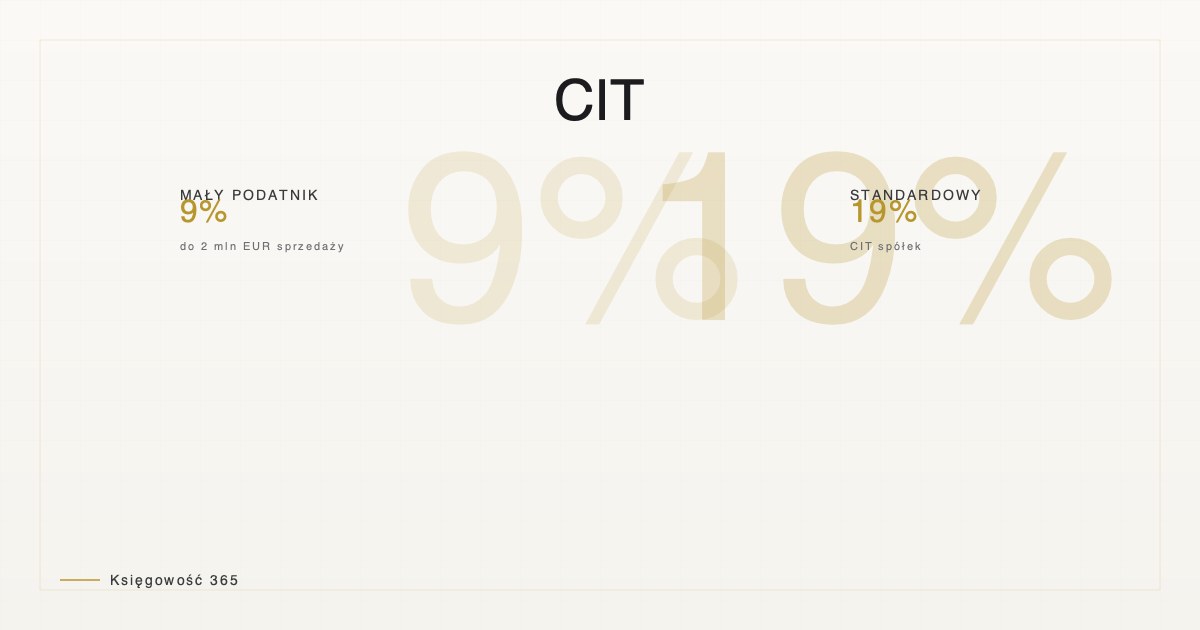
Income Tax in Poland — Architecture of the Tax System
The Polish tax system is based on two pillars: PIT (personal income tax) and CIT (corporate income tax). This distinction is crucial for understanding what optimization tools are available in your situation.
PIT (Personal Income Tax) applies to individuals conducting business activities, as well as individuals employed under employment contracts. PIT is governed by the Act of July 26, 1991 on personal income tax.
CIT (Corporate Income Tax) taxes capital companies such as Limited Liability Company (Sp. z o.o.), Joint-Stock Company (S.A.), and other legal entities. CIT is governed by the Act of February 15, 1992 on corporate income tax.
Choosing between PIT and CIT is one of the fundamental decisions for every entrepreneur. Depending on the organizational form of your business, tax system, and planned development, significant differences in annual tax liability can emerge.
PIT — Personal Income Tax
How Does PIT Work in Poland?
Every individual earning income is obligated to pay PIT. This applies to both salaried employees and entrepreneurs conducting business activities. Poland operates a system where the taxpayer settles with the tax authorities — usually through the employing company, which withholds prepayments, or by filing an annual tax return.
The primary document for PIT settlement is the PIT-36 or PIT-37 tax return (for entrepreneurs). The difference between them is significant:
- PIT-36 — for individuals earning income from employment contracts, service contracts, pensions, and annuities
- PIT-37 — for individuals conducting business activities (entrepreneurs filing PIT)
For entrepreneurs conducting independent activities (sole proprietorships) it's possible to choose one of two tax systems: progressive scale or 19% flat tax.
Progressive Scale vs. 19% Flat Tax
This is one of the most important decisions for every entrepreneur. The choice between progressive scale and flat tax can save or cost thousands of PLN annually.
| Annual Revenue | Progressive Scale (2026) | 19% Flat Tax | More Advantageous |
|---|---|---|---|
| 50,000 PLN | ~3,150 PLN | 9,500 PLN | Progressive scale |
| 100,000 PLN | ~10,200 PLN | 19,000 PLN | Progressive scale |
| 150,000 PLN | ~18,500 PLN | 28,500 PLN | Progressive scale |
| 200,000 PLN | ~28,900 PLN | 38,000 PLN | Progressive scale |
| 250,000 PLN | ~39,500 PLN | 47,500 PLN | Progressive scale |
Progressive Tax Scale in 2026:
- Up to 120,000 PLN — 12% tax + 3,600 PLN deduction
- Above 120,000 PLN — 32% tax + 19,920 PLN deduction
From the analysis, it appears that revenue below approximately 160,000 PLN annually is better taxed under the progressive scale. Above this threshold, the 19% flat tax may be more advantageous. However, this is not the only variable — you must also consider cost deductions and available tax credits.
Cost Deductions in PIT
Entrepreneurs filing PIT can deduct actual costs incurred during business operations. Under Article 22 of the PIT Act, business expenses are considered costs directly related to earning income.
Typical business expenses for entrepreneurs include:
- Employee compensation costs (salaries, social security contributions)
- Office or premises rental
- Materials and raw materials
- Services: consulting, accounting, legal
- Energy, internet, phone costs for business
- Depreciation of fixed assets
- Property and travel insurance
- Employee training and development costs
Alternatively, if you work from home, you can use the home office flat allowance. In 2026, the allowance is 120 PLN monthly (1,440 PLN annually), without needing to document actual costs.
CIT — Corporate Income Tax
CIT System — Which Companies?
CIT applies to capital companies (Limited Liability Company, Joint-Stock Company, European Company, European Cooperative Society) and certain other legal entities. The main difference from PIT is that CIT is taxed at the company level, and then potentially at the shareholder level upon dividend distribution.
The CIT rate in Poland is 19% of company income. This is a flat rate, regardless of company income size. However, Polish legislation provides exceptions and credits that can reduce the effective tax rate.
Standard CIT vs. Estonian CIT
Since 2019, capital companies can choose a more favorable Estonian CIT system (equity tax), regulated by Articles 27h-27zs of the CIT Act.
Standard CIT 19% — taxation at company level:
- Company income is taxed with CIT at 19%
- Reinvested profit (retained in the company) is not subject to additional taxation until dividend distribution
- Dividends paid to shareholders are taxed with PIT at 19% (preferential rate on investment income)
Estonian CIT — taxation of dividends instead of profit:
- Company income is NOT taxed with CIT, as long as profit is reinvested in the company
- CIT (19%) is only levied at the moment of dividend distribution to shareholders
- This means capital can grow without taxation until distribution
When to Choose Estonian CIT? Estonian CIT is advantageous for companies that:
- Plan to reinvest most profits
- Don't need regular dividend distributions
- Build capital for future investments
When is Standard CIT Better? Standard 19% CIT is advantageous for companies that:
- Regularly distribute dividends to shareholders
- Want to divide profits among shareholders
- Don't plan significant reinvestment
Real Example: Estonian CIT vs. Standard
Assume a Limited Liability Company earns net profit of 100,000 PLN annually, and the shareholder wants to distribute a dividend.
Scenario 1: Standard CIT 19%
- Company profit: 100,000 PLN
- CIT to pay: 19,000 PLN
- Remaining profit for distribution: 81,000 PLN
- PIT on dividend for shareholder: 81,000 × 19% = 15,390 PLN
- Net dividend for shareholder: 65,610 PLN
- Total tax (CIT + PIT): 34,390 PLN (34.39%)
Scenario 2: Estonian CIT with Reinvestment
- Company profit: 100,000 PLN
- CIT to pay: 0 PLN (profit reinvested in company)
- Company capital grows to: 100,000 PLN
- Tax deferred until dividend distribution
- Effective tax rate this year: 0%
The difference is significant. In Scenario 2, the company can reinvest the entire profit without taxation, enabling faster capital and revenue growth.
IP Box — Credit for Innovative Companies
If your company earns income from intellectual property (patents, software copyrights, trademarks, know-how), you can use the IP Box credit (patent box).
Under Article 27 of the CIT Act, when a company earns IP income, it can reduce the tax base by 5% to 30% of income from that activity. This reduction applies only to intellectual property income.
What Assets Qualify for IP Box?
- Patents and inventions
- Software and source code
- Copyrights (for scientific, artistic, literary works)
- Semiconductor topographies
- Registered trademarks (for certain business models)
Example: A company develops software. Revenue from license sales is 200,000 PLN. Based on IP Box, this revenue can be reduced by 20%, reducing the tax base by 40,000 PLN. At 19% CIT rate, this saves 7,600 PLN annually.
Tax-Free Threshold in 2026
The tax-free threshold is the amount below which a taxpayer pays no income tax. In 2026, the tax-free threshold is 44,536 PLN.
This means if your annual income (revenue minus costs) is below 44,536 PLN, you don't pay PIT. However, you are still obligated to:
- File a tax return (PIT-37)
- Pay social security contributions (if you're an entrepreneur)
- Repay prepayments if you paid them earlier in the year
For a salaried employee, the tax-free threshold works automatically — your employer withholds PIT prepayments, and if your income is below the threshold, you receive a tax refund during annual settlement (PIT-36).
Additional Credits for Selected Taxpayer Groups
Besides the basic tax-free threshold, Polish legislation provides additional credits for selected groups:
- Young Entrepreneur Credit (under 26) — full PIT exemption for the first 2 years of business, then 9% reduced rate for the next 3 years
- Senior Credit (55+) — reduced filing requirements and preferential business conditions
- Scientist Exemption — for income from research and scientific activities
Income Tax Prepayments — Monthly vs. Quarterly
PIT taxpayers who expect annual income above the tax-free threshold must make income tax prepayments. Prepayments can be made:
- Monthly — by the 15th of the month following the month income was earned
- Quarterly — by the 15th of the month following the quarter (default)
You can request a change in payment frequency with the tax authority through a CIT-8A form or letter to the tax inspector.
For companies (CIT), prepayment is typically made:
- Monthly — by the 15th of the following month, at 1/12 of prior year tax
- After annual settlement, you settle any difference (refund or additional payment)
It's worth planning prepayments so you don't face a large lump sum at annual settlement. We advise entrepreneurs to regularly monitor income and adjust prepayments accordingly.
Tax Credits in 2026
The Polish tax system offers various credits that can reduce your final tax bill. Many are underutilized by taxpayers.
Child Credit (Family Credit)
Each school-age child entitles you to a tax credit. The credit amount in 2026 is:
- 1 child — 1,112.04 PLN annually (92.67 PLN monthly)
- 2 children — 2,224.08 PLN annually (185.34 PLN monthly)
- 3 children — 2,224.08 PLN annually (185.34 PLN monthly)
- 4 or more children — 4,448.16 PLN annually (370.68 PLN monthly)
This credit is available to families regardless of income level. It's a direct tax reduction (tax credit, not a base deduction).
Thermomodernization Credit
If you've done modernization work to reduce home energy consumption (e.g., window replacement, wall insulation, gas furnace installation), you can deduct 10% of work costs from taxes.
The credit is available to individuals using a residential building for personal use. Maximum annual credit is 8,000 PLN, and total credit over all years is 30,000 PLN.
Rehabilitation Credit
Individuals with disabilities can deduct 100% of rehabilitation-related costs, but maximum 5,500 PLN annually. This includes both personal costs and assistant employment costs.
Charitable Donation Deduction
Donations to charitable purposes (to public benefit organizations) can be deducted from taxes up to 6% of net income, but not more than 27,000 PLN annually.
Tax Envelope (Preferential Treatment of Investment Income)
Income from capital gains (from stocks, bonds, fund units) is taxed at 19% preferential rate instead of being added to other income. In practice, this means even if you have high work income, investment gains are taxed at 19%.
Annual Settlement — Deadlines and Forms
Every entrepreneur and income earner must file an annual tax return. Deadlines in 2026 are:
- File PIT/CIT return — by April 30, 2026 (for entities not paying social contributions) or by June 30, 2026 (for entities paying social contributions)
- File CIT-8A declaration — by the 20th of the month following the quarter
- File annual CIT settlement — within 3 months of end of fiscal year
Forms:
- PIT-36 — for employed individuals, retirees, annuitants
- PIT-37 — for entrepreneurs (self-employment)
- CIT-8 — annual tax return for companies
- CIT-8A — tax prepayment declaration for companies
All forms must be filed electronically through the taxpayer portal (e-Tax Authority) or tax settlement software. Paper returns are no longer accepted by the tax authority.
Frequently Asked Questions About Income Tax
Q: Is it better to choose the progressive scale or 19% flat tax?
A: It depends on your income. For revenue up to approximately 120-160 thousand PLN annually, the progressive scale is more favorable. Above this threshold, consider the 19% flat tax. Remember — this choice can be changed in the next tax year if circumstances change.
Q: What are the tax-free thresholds in 2026?
A: The personal income tax-free threshold in 2026 is 44,536 PLN. For certain groups (young people under 26, seniors 55+) there may be additional credits. Remember that a tax-free threshold doesn't mean no obligations — you must still file a tax return and pay social contributions.
Q: Is Estonian CIT always a good option?
A: Estonian CIT is beneficial for companies reinvesting profits. If you regularly distribute dividends, Estonian CIT may be less favorable due to dividend taxation. It's worth recalculating both options each year based on your business plan.
Q: When can I use the IP Box credit?
A: IP Box applies to capital companies earning intellectual property income — patents, software, copyrights, trademarks. The credit reduces the tax base by 5-30% of IP income. If you develop software or intellectual products, definitely consult with a tax advisor about eligibility.
Q: How often must I pay income tax prepayments?
A: PIT prepayments can be made monthly (by the 15th) or quarterly (default, by the 15th of the following month). You can request a frequency change with the tax authority. For CIT, prepayment is typically monthly. You can also request exemption from prepayments under certain conditions.
Q: Can I deduct home office costs from income tax?
A: Yes, but only for actual business costs. You can choose between actual cost deduction (rent, utilities, internet — proportional to office space) or flat rate method. The flat rate for home office in 2026 is 120 PLN/month (1,440 PLN annually) — more economical for most small home-based businesses.
Summary and Recommendations
Income tax in 2026 remains a complex matter requiring individual approach. Key decisions affecting your final tax bill:
- Organizational Form — choice between PIT and CIT fundamentally affects your effective tax rate
- PIT Tax System — progressive scale vs. 19% flat tax — should be reassessed annually
- Utilize Credits — many taxpayers don't use all available credits (IP Box, thermomodernization, children)
- Timing Planning — invoice or payment timing can affect prepayment management
- Profit Reinvestment — for capital companies, Estonian vs. standard CIT depends on dividend strategy
There is no universal solution for everyone — each situation is individual. We recommend consulting with a tax advisor, which can save you thousands of PLN annually.
Disclaimer — Important Information
This article provides educational guidance on Poland's tax system. The information is provided for informational purposes only and does not constitute tax or legal advice. Every tax situation is individual — before making final decisions about tax system choice, credits, or settlement, always consult with a tax advisor or accountant. The Ministry of Finance and National Tax Administration may introduce procedural changes — follow official announcements on mf.gov.pl and the e-Tax Authority.
Do You Need Help with Tax Optimization?
Księgowość 365 specializes in tax consulting and tax structure optimization. We offer:
- Consultations on tax system choice (PIT vs. CIT, progressive vs. flat)
- Analysis of available credits (IP Box, thermomodernization, children)
- Tax planning for growing businesses
- Complete annual settlements (PIT-36, PIT-37, CIT-8)
- Handling tax prepayment calculation and payment
Schedule a free tax consultation
Related Articles
Piotr specializes in tax consulting for entrepreneurs and companies. For 18 years he has supported businesses in choosing optimal tax structures, tax planning, and compliance. Author of numerous publications on tax law changes.
Registration: Tax Advisor